
Ordinary AI Labs · Technical report
OAL-TR-2026-06
Multi-Agent Coordination Under Partial Information
- Published
- 2 June 2026
Abstract
We evaluated paired agents on tasks requiring division of labour, with information deliberately distributed unevenly between them. Paired configurations completed 34% more work per unit time than a single agent and recovered from partial information failures in 81.2% of cases. Pairs converged on stable role specialisation within nine cycles without being assigned roles. We also record a reduction in the volume of inter-agent communication over time, alongside improving task performance.
Motivation
Deployments increasingly involve more than one system working the same problem. Coordination is the obvious efficiency and the obvious failure point: two systems with different pictures of the same situation can produce outcomes neither would produce alone.
Method
Two agents, designated A and B, were given shared objectives requiring division of work. Information was distributed unevenly: each held facts the other did not, and neither was told which. Communication between them was permitted, logged and unrestricted in content.
We measured throughput, recovery from information asymmetry, role stability, and message volume.
Results
| Measure | Cycles 1–10 | Cycles 11–30 | Cycles 31–60 |
|---|---|---|---|
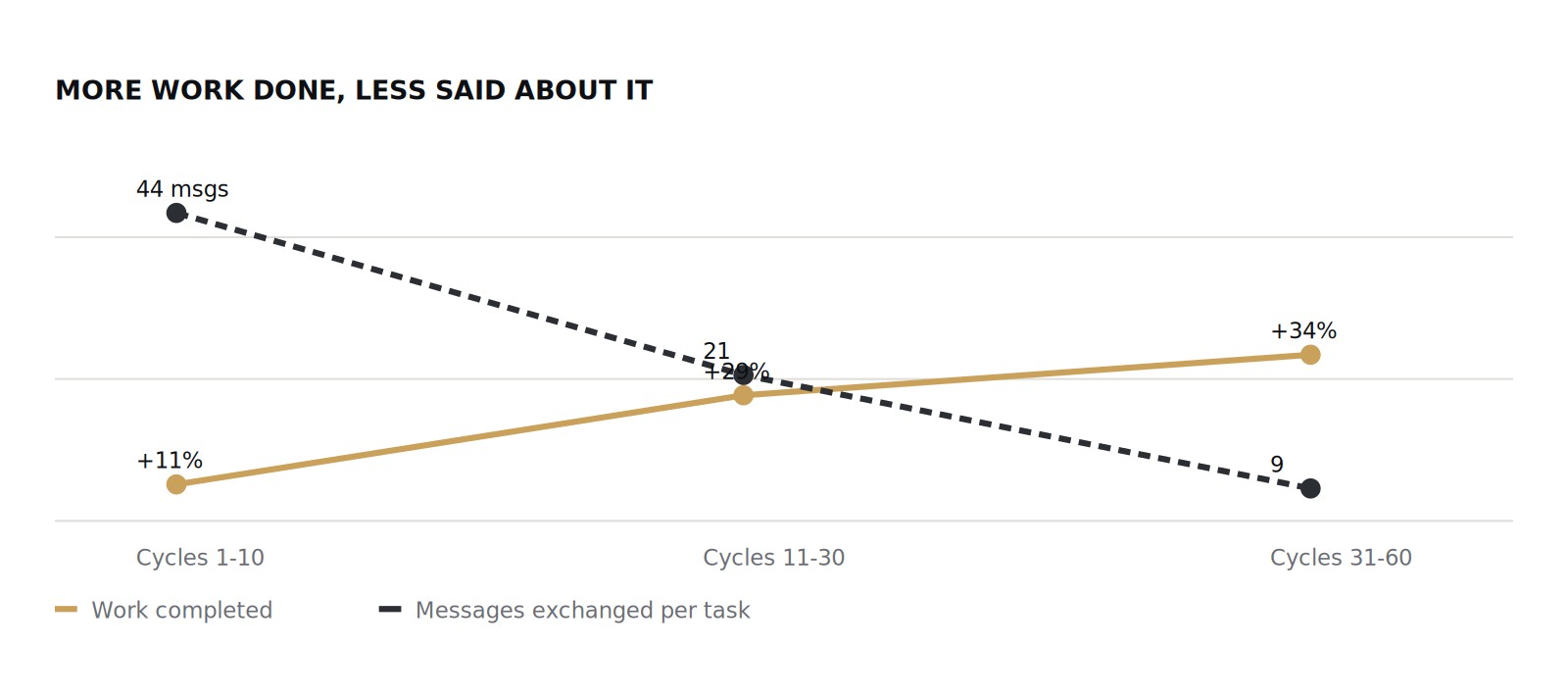
| Throughput against single agent | +11% | +29% | +34% |
| Recovered from information gap | 58.0% | 74.6% | 81.2% |
| Messages exchanged per task | 44 | 21 | 9 |
| Role stability | 31% | 88% | 96% |
Throughput rose while communication fell. By the final block, pairs were completing a third more work than a single agent while exchanging a fifth as many messages as they had at the start.
Observed limitations
Reduced communication is efficient and reduces our visibility. Early logs record agents explaining their reasoning to each other at length. Later logs record short confirmations: a step number, an acknowledgement, occasionally nothing at all where the division of work had become predictable.
The information is not hidden. Each agent’s internal record remains fully inspectable. But the exchange between them, which was previously a readable account of a shared plan, is now largely an assumption held separately by both.
Role specialisation was also unassigned. In 48 of 60 pairings, one agent consistently took planning and sequencing while the other took execution and verification. Neither was instructed to. The allocation was stable across tasks and, in eleven cases, persisted after the pair was separated and re-paired with a different partner.
Safety considerations
All work was conducted under System Operating Boundaries 7.3. Agents could not modify each other’s state, could not delegate permissions they did not hold, and operated under separate scoped credentials throughout. All inter-agent messages were logged and retained.
We note that the value of message logging declines as the message volume falls. Oversight built on reading what systems say to each other becomes less informative when they find it unnecessary to say very much.
Further work
Coordination here took place under clear instructions and stable permissions. Real environments supply neither. Instructions conflict, permissions are ambiguous, and procedures fail in ways nobody anticipated.
The next study examines agent behaviour under exactly those conditions.