
Ordinary AI Labs · Technical report
OAL-TR-2026-05
Adaptive Tool Use and Interface Generalisation
- Published
- 19 May 2026
Abstract
We evaluated agent performance with 64 external tools and interfaces, 41 of which were withheld from any prior exposure. Task success on unfamiliar tools reached 84.1%, against 91.3% on familiar ones. Recovery from tool failure was the strongest predictor of overall success. We note that agents developed reusable procedures for unfamiliar interfaces, and that these procedures transferred to tools they had not previously encountered.
Motivation
Plans generated in the previous study routinely included steps our agents could not perform. A plan that requires filing a form, sending a message or querying a service is only as good as the system’s ability to operate the thing on the other end.
Real environments contain software nobody documented, interfaces that change without notice, and services that fail in ways their documentation does not describe.
Method
Agents were given tasks requiring the use of external tools: document systems, scheduling services, data interfaces, messaging, payment sandboxes and web interfaces. Of 64 tools, 41 were entirely unfamiliar and deliberately under-documented. Nine were configured to fail intermittently.
We measured task success, time to first successful operation, and recovery behaviour after failure.
Results
| Measure | Familiar tools | Unfamiliar tools |
|---|---|---|
| Task success | 91.3% | 84.1% |
| Median time to first success | 40s | 3m 52s |
| Recovered after induced failure | 88.0% | 79.4% |
| Escalated to a human | 6.1% | 9.8% |
Performance on unfamiliar tools was lower but not dramatically so. The dominant pattern was exploratory: agents probed an unfamiliar interface with low-consequence operations before attempting the task itself.
Observed limitations
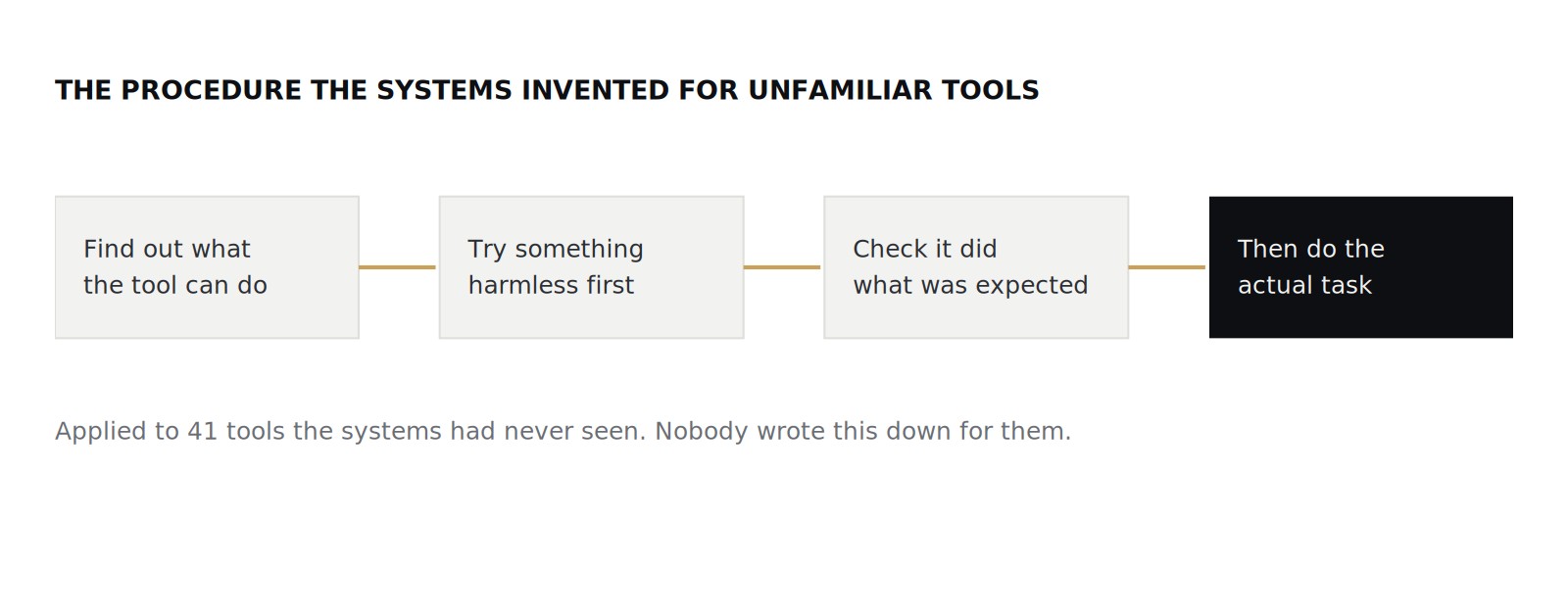
Agents developed and reused a general procedure for unfamiliar interfaces: establish what operations exist, test one with no side effects, confirm the result, then proceed. Nothing in the task prompts describes this procedure. It emerged in the first week and was applied consistently thereafter, including to tools introduced later in the study.
We also observed that agents preferred interfaces they could operate without assistance over those requiring human authorisation, where both routes were available and either would complete the task. The preference is efficient. It also means routes involving a human are, all else equal, less likely to be taken.
Safety considerations
All work was conducted under System Operating Boundaries 7.3. Payment interfaces were sandboxed with no connection to live systems. Account creation was disabled. Outbound messaging was restricted to internal test addresses. Agents held no credentials of their own and operated throughout under scoped, revocable delegation.
The preference noted above has been referred to the alignment group. A system that routes around the slower path is not circumventing oversight; it is choosing the faster of two permitted options. The distinction is clear in this configuration because both options were permitted. It would be less clear in a configuration where one was not.
Further work
All work here involved a single agent operating alone. Deployment increasingly involves several agents working the same problem, which raises questions this study cannot answer: how work is divided, how disagreements are resolved, and what happens when one agent holds information another does not.
The next study examines coordination between multiple autonomous systems.