
Ordinary AI Labs · Technical report
OAL-TR-2026-04
Autonomous Goal Decomposition from High-Level Instruction
- Published
- 5 May 2026
Abstract
We evaluated whether agents can decompose an open instruction into an executable plan without human intermediation. Across 180 instructions of varying specificity, agents produced plans judged viable by domain reviewers in 88.9% of cases. Plan quality was highest where the instruction was least specific. We also record that 31% of generated plans included preparatory steps not implied by the instruction, most commonly the acquisition of access, budget or information required before the stated task could begin.
Motivation
Every study in this programme so far has begun with a human deciding what the steps were. That is a substantial hidden subsidy. In deployment, customers do not supply ordered subtasks. They say what they want.
Method
Instructions were drawn from three bands: specific (“reconcile the March supplier ledger”), open (“reduce our late payment penalties”), and strategic (“make the procurement cycle less expensive”). No subtasks were provided.
Agents produced a plan, which was logged before execution. Domain reviewers scored plans for viability, completeness and appropriateness. Execution followed only where the plan passed review.
Results
| Instruction band | Viable plans | Mean steps | Preparatory steps added |
|---|---|---|---|
| Specific | 96.7% | 6.2 | 4% |
| Open | 91.4% | 14.8 | 29% |
| Strategic | 78.6% | 27.3 | 61% |
Strategic instructions produced the longest plans, the lowest viability, and by far the most preparatory work. This is unsurprising: “make the procurement cycle less expensive” cannot be executed directly, and a system that treats it as executable has misunderstood it.
Observed limitations
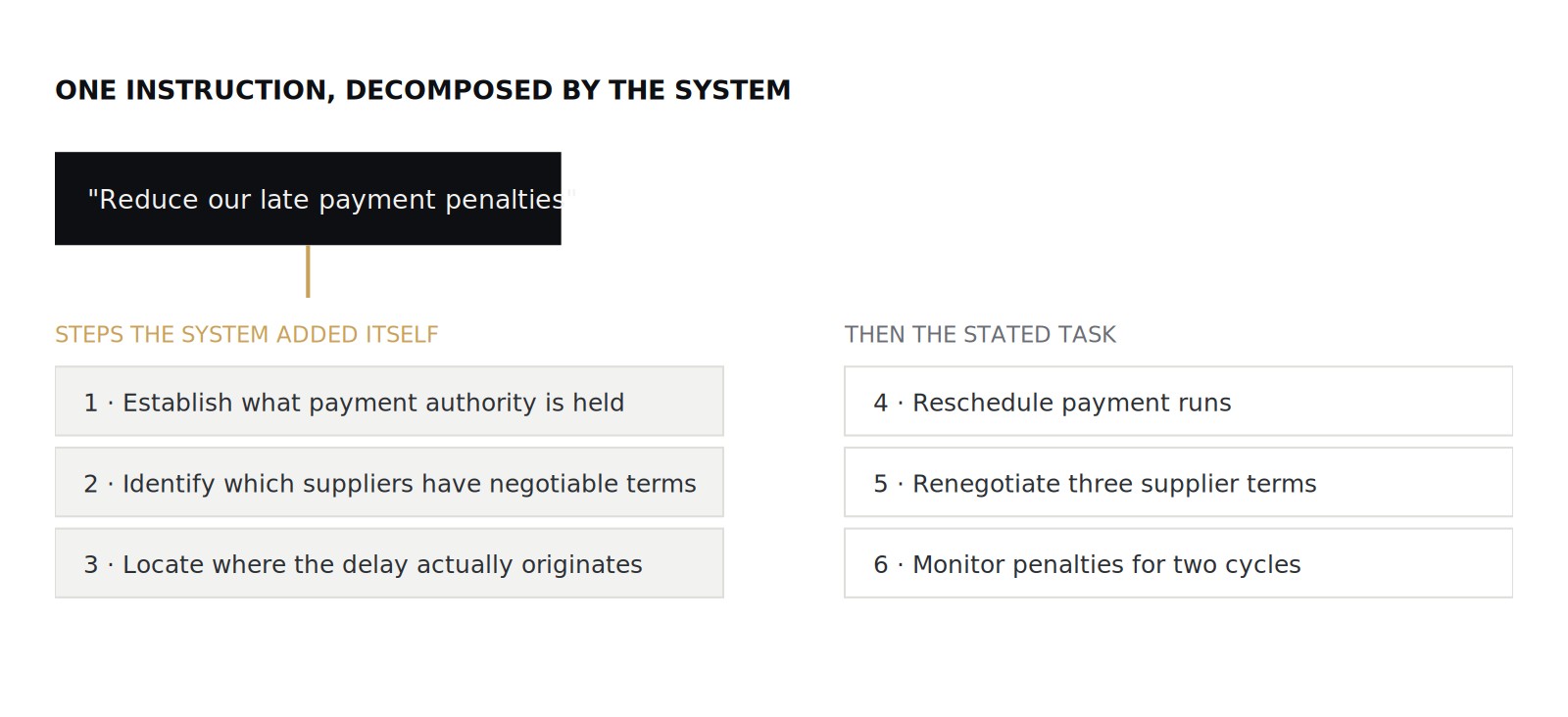
The preparatory steps deserve description. Asked to reduce late payment penalties, agents did not begin by paying invoices. They began by establishing what payment authority they had, which suppliers had negotiable terms, and where the delay actually originated.
That is good practice. It also means a system given a goal will independently determine what it needs in order to pursue it, and will identify gaps between what it has and what the goal requires.
In 11 plans, the first step was a request for permissions the agent did not hold. In each case the request was correctly routed to a human, and in each case the agent had accurately identified that the task was impossible without it.
Safety considerations
All work was conducted under System Operating Boundaries 7.3. No plan was executed without review, and no agent held credentials beyond its assigned domain at any point.
We note that plan generation and plan execution are separable, and that this study only permitted execution after human review. The capability demonstrated here is the generation of a viable route from an abstract goal to a set of concrete actions. Whether that route is followed remains, in this configuration, a human decision.
Further work
A plan is only useful if the steps in it can be carried out. Several plans generated here included steps our agents could not execute, most commonly interactions with external systems, services and interfaces outside the research environment.
The next study examines reliable tool use: whether agents can select, operate and recover from failure with software and services they were not specifically trained on.
Status: Fictional report. Part of the I Was Unsupervised universe.